
Pembroke Court Docket Searches
Pembroke publishes no online docket database. No public session calendar exists either. A Pembroke court docket search therefore starts on the official Police Department page, which offers a Municipal Court route and an Online Citation Payment route. Keep the citation or case number. Have the exact name used in the case too. If the web route cannot find the matter, contact the city police or the municipal clerk instead of assuming it ended.
- Check the issuing agency and named court.
- Open Pembroke's official citation-payment path for a city ticket.
- Use the exact citation number and requested details.
- Call or visit the city municipal channel if no match appears.
- Ask for the docket, setting, or certified disposition by name.
- Use Bryan County CM Web only for a county court case.
A targeted written request is the last city fallback. State the court, the citation or case number, and the party name. Say which record you want. Do not expect the county clerk to certify a Pembroke municipal file.
Pembroke City and County Split
Sitting in the county seat does not merge courts. Pembroke Municipal Court stays separate from Bryan Superior, State, Magistrate, and Probate Court. The city court keeps traffic, ordinance, and nuisance cases. Bryan County offices in Pembroke hold the county cases. You can be in the right town and still ask the wrong office. City Hall lists P.O. Box 130, Pembroke, GA 31321 and 912-653-4413 as the public city contact. Start there for any city record. County felonies, divorce, equity, and land matters go to Superior Court. Misdemeanors and county traffic go to State Court. Small claims up to $15,000 and dispossessory matters go to Magistrate Court.
Inside the Pembroke Municipal Court
Pembroke Municipal Court handles city traffic citations. It also handles ordinance prosecutions and a distinctive set of nuisance matters. Its code lays out how a written accusation starts a case. It explains how a summons issues too. The code covers pleas, continuances, evidence, witnesses, dismissals, judgments, and sentences. Those steps generate docket events even without a public web calendar. City jurisdiction has limits. A Pembroke address alone creates no city case. A felony or a county civil claim stays in county court. The docket follows whichever court holds legal authority over the charge. Read the issuing document before picking a portal.
Pembroke Police Opens the First Door
The official Police Department page is the best online entry point. It carries a Municipal Court route and an Online Citation Payment route. A payment screen can locate an eligible citation. It is not a full public docket database. Settings, filed events, older records, and certified results may not appear on the vendor site. For those, direct contact with the clerk remains necessary. The official Pembroke Police and citation page shows both municipal routes on one city page. It ties the court function to the police channel.
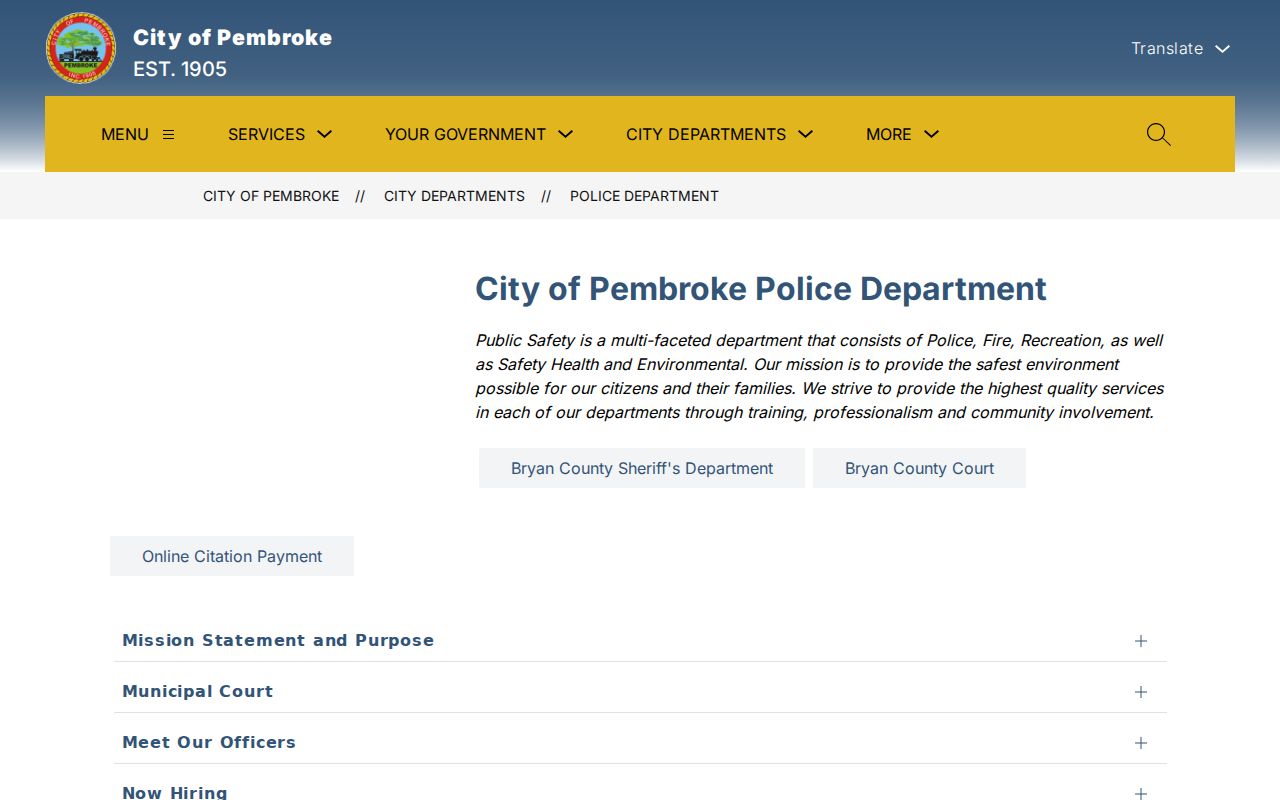
The page shows where a city search starts. The clerk remains the source for the record itself and any current setting.
Finding Pembroke Court Dates
The city publishes no regular session calendar. Do not invent a recurring court day. A payment screen is not a dependable setting notice. The citation, summons, or a later notice from the court supplies the operative date. Confirm directly with the city, especially after a continuance request or when no calendar entry appears online.
| Date | Use the citation, summons, or latest court notice. |
|---|---|
| Time | Confirm directly because no regular online calendar was found. |
| Location | Follow the city court notice or obtain city confirmation. |
| Case Source | Citation, verified accusation, or docketed nuisance complaint. |
| Setting Type | Plea, preparation continuance, hearing, trial, or disposition event. |
A filed request changes nothing by itself. The court must act, so keep the newest notice and ask the clerk whether a later term, hearing, dismissal, or judgment has been entered.
Pembroke Accusations Start in Writing
Pembroke's code lets anyone with knowledge of an ordinance violation file a written verified accusation with the clerk. Verified means the filer formally affirms the charge. The clerk then issues a summons for personal service by the police chief. That summons requires appearance at the next court term.
- Accusation
- A written charging statement alleging a city ordinance violation.
- Verified
- Formally affirmed by the person who claims knowledge.
- Summons
- The court-issued command to appear at the next term.
- Continuance
- A court-authorized delay to a later term for preparation.
The court decides whether reasonable grounds exist. It may then proceed toward trial. Both the prosecutor and the accused may seek the preparation continuance described in the city procedure, though a request is not the same as a granted delay.
Pembroke Traffic Ticket Lookups
A ticket written into Pembroke Municipal Court stays in the city channel. County traffic belongs to Bryan State Court. The issuing agency and the court named on the citation control where the case goes, not the driver's address. Pembroke holds county offices, but that changes nothing. Payment can carry a plea consequence. Paying online is not a neutral act. Anyone contesting a charge should follow the stated response and appearance process. If the vendor cannot find the ticket, call 912-653-4413 and ask for the municipal contact. Have the exact citation details ready. The Bryan County traffic court record page covers county citations. It does not replace direct Pembroke confirmation for a city ticket.
Pembroke Nuisance Cases Take Another Path
A nuisance complaint enters the Pembroke municipal docket by a different door. It does not arrive like a speeding ticket. A resident or an official can file a complaint with police. Police then investigate and may set the matter on the Municipal Court docket. Animal-control officers, license inspectors, and building inspectors hold the same power within their own roles.
From there the process is straightforward. The court sends ten-day notice and holds a hearing. It can order abatement, meaning correction or removal of the condition, within a reasonable time. Some Pembroke court records open with an investigation. Others open with a complaint rather than a traffic citation.
Ten-day notice matters. A nuisance file can include the complaint, investigation, notice, hearing, findings, and any order to abate.
How Pembroke Cases Reach County
Not every Pembroke case stays in Pembroke. City traffic, ordinance, and nuisance matters belong to Pembroke Municipal Court. Bryan State Court takes county misdemeanors and county traffic. Felonies, divorce, land, and equity matters go up to Superior Court, while a small claim of no more than $15,000 normally belongs in Magistrate Court.
Docket flow: Pembroke Municipal Court › Bryan County Courts › Superior Court
The hierarchy also hints at review. A municipal case does not turn into a county State Court case on its own. Superior Court supplies the route for reviewing lower municipal decisions. Search the Bryan County docket only when jurisdiction, a transfer, or a review points there.
Pembroke Pleas and Court Outcomes
The city code sets the rules for pleas. Before accepting one, the court must address the charge. It must cover the possible penalty and the rights the procedure describes. Indigent defendants get appointed counsel where required. These are court events, and the online payment vendor has nothing to do with them.
A Pembroke docket can show a continuance. It may list witness activity, evidence, a dismissal, a judgment, or a sentence. Think of the docket entry as the index. The signed judgment or certified disposition is the official paper behind it. Ask for that paper when the result must be proven.
| Event | Meaning |
|---|---|
| Plea | The accused person's formal response to the charge. |
| Continuance | A granted move to a later term. |
| Dismissal | Termination reflected by court action. |
| Judgment | The court's formal decision. |
| Sentence | The result imposed after the required process. |
Who Can See Pembroke Records
Anyone can seek public Pembroke municipal records from the city custodian. Use the citation route, a phone call, an in-person visit, or a targeted written request. The Georgia Open Records Act backs access to public agency records. Even so, judicial confidentiality, sealing rules, and protected identifiers still control what a court file can reveal.
Key Rules:
Georgia Open Records Act, O.C.G.A. § 50-18-70 et seq. supports inspection and copying, subject to court-specific restrictions.
Georgia electronic-filing minimum standards require a no-cost courthouse option for public electronic documents during regular hours.
Juvenile files, sealed material, and protected identifiers never show up as ordinary public results. A blank screen can simply mean the wrong custodian or an older record held offline. Ask whether access is restricted, but do not expect the clerk to disclose sealed contents.
Pembroke City Sources Stay Separate
The city's public identity page and its Police Department page do different jobs. One gives the general Pembroke contact. The other offers the practical Municipal Court and payment paths. Neither replaces Bryan County CM Web. Neither replaces the county clerk's certified record service either. The official City of Pembroke source lists the city-level contacts that anchor that first step.

Put together, these city pages trace a sensible fallback chain. Try the city site, then the Police Department municipal route, then direct clerk contact with a focused record request.
Confirm Pembroke Court Records
Bring the citation or case number. Use your name exactly as printed. Say whether the matter is traffic, ordinance, or nuisance-related. Then ask for the current setting, docket entry, or certified disposition. A precise request helps city staff tell a payment question from a court-record request.
If the city says it does not hold the matter, name the right county court. Then search again. State Court handles county misdemeanors and traffic. Superior Court handles general-jurisdiction matters. Magistrate Court handles limited civil and preliminary work. Going court-first keeps a missing Pembroke web result from being misread as proof that no public case exists.