
Bryan County Criminal Docket Searches
Most people begin at Bryan County CM Web Search. Accept the accuracy disclaimer first. Then pick a party search or a case-number search, and check that the result names the court you expected. The portal itself advises trying every plausible spelling of a proper name. A case number is the safer key. It cuts down false matches.
A blank result is not proof that no case exists. Older files sit offline while the clerk scans records. City citations stay with Richmond Hill or Pembroke Municipal Court, and protected juvenile cases are not part of a routine public search.
- Identify the court from the notice, citation, or charge level.
- Accept the CM Web disclaimer and use the exact case number when possible.
- For a name search, try spelling variants and check the court and caption.
- Read entries in date order, including later resets, orders, pleas, or dispositions.
- Call the proper division or request certification when official proof is needed.
Bryan Criminal Cases in CM Web
The official search-by-party route makes clear that a name is only a starting key. You still have to match Bryan County, the court class, and the criminal caption. Dropdowns and status codes carry no published gloss. So assume no unofficial mask or code.
That official Bryan County route is what the page depicts.
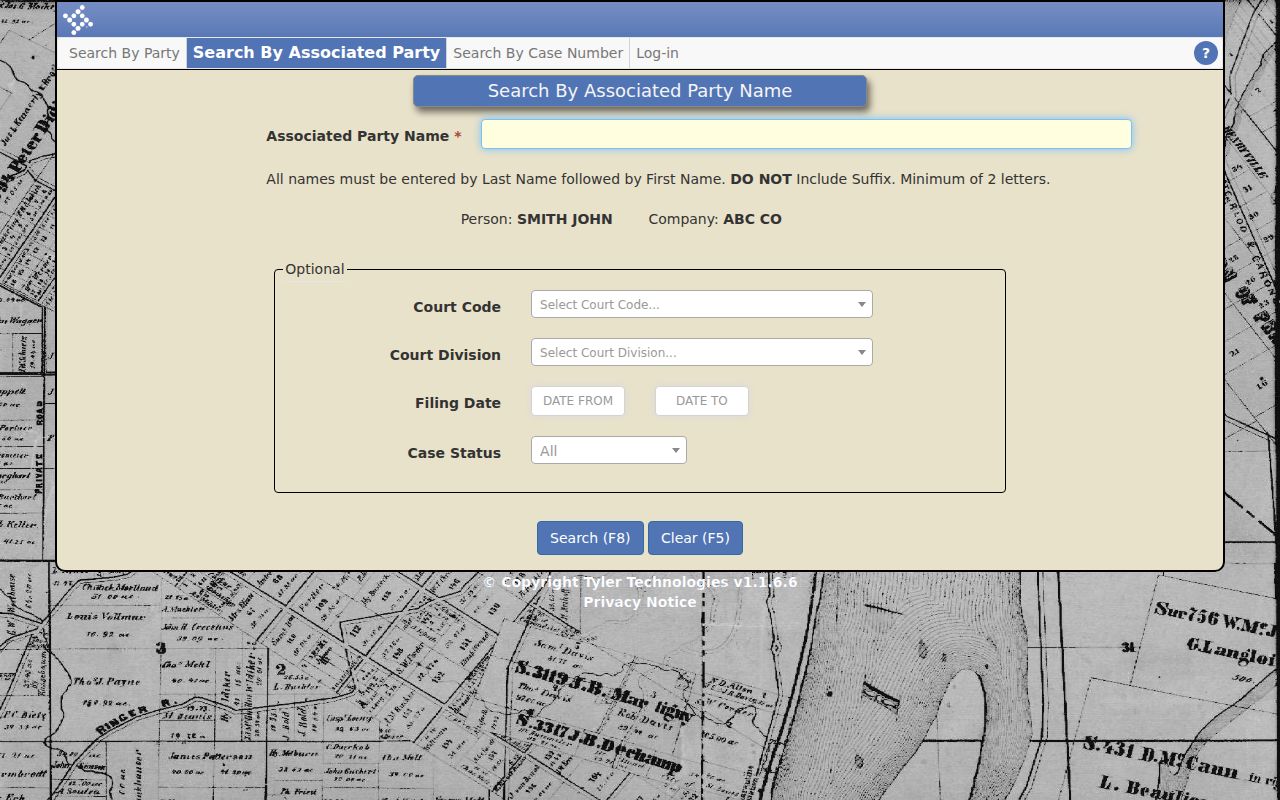
The interface helps with lookup. When a web display differs from the official record, the clerk's file and signed orders control.
Criminal Dockets: What They Show
Think of a Bryan County criminal docket as a layered index. The header identifies the court, case, caption, filing date, and status. Below it, the event list tracks charging activity, hearings, motions, orders, pleas, and the result. An entry labeled "Order" confirms that an order was entered, but its exact terms live in the signed image or clerk copy.
| Case number | The clerk identifier, entered as shown, such as the number on the notice. |
|---|---|
| Charge | An accusation, indictment, count, and statute or class where public. |
| People and counsel | The State-versus caption, accused person, and attorneys. |
| Settings | Arraignment, pretrial, motion, plea, trial, or sentencing dates. |
| Outcome | Dismissal, nolle prosequi, plea, verdict, sentence, or appeal activity. |
Bryan Criminal Courts Split the Work
Jurisdiction decides where a Bryan County criminal docket lives. Felonies belong to Superior Court. State Court generally handles misdemeanories and county traffic, while Magistrate Court takes warrants, preliminary hearings, bail within its authority, and some minor matters. Richmond Hill and Pembroke keep the city traffic and ordinance records.
| Court | Role | Contact |
|---|---|---|
| Superior | Felonies | Clerk, 912-653-3872 |
| State | Misdemeanors | Criminal deputy, 912-653-3875 |
| Magistrate | Warrants and preliminary matters | 912-653-3860 |
| Municipal | City citations | Issuing city clerk |
A city citation does not hop into State Court just because it arose inside Bryan County. Search the court that opened it.
Criminal Case Stages on the Docket
Not every case hits every stage, but the sequence still tells its story. A warrant or charging instrument comes first. Bond and first-appearance activity may follow. An accusation commonly opens a State Court prosecution, while an indictment is the grand-jury charging document in Superior Court felony work.
Docket flow: Filing › Arraignment › Pretrial › Plea or Trial › Disposition › Sentencing
Between those points, expect discovery, motions, continuances, and orders. Read past the first setting. A later notice may replace it, and post-judgment motions or an appeal can keep the file open after sentence.
Bryan State Forms Explain Entries
Bryan State Court publishes forms for waiver of arraignment and not-guilty plea, plea in absentia, discovery, interpreter notice, continuance, redocketing, and its family-violence program. Those names help decode docket entries. They do not mean every request was granted.
Waiver of arraignment: a filed waiver that may replace an appearance at the formal plea stage.
Continuance: an authorized postponement. A request alone does not cancel a setting.
Redocket: restoration of a matter to an active calendar.
Disposition: the conclusion, checked against the signed order or sentence.
Bryan County Criminal Docket Courts
Rebecca G. Crowe, Clerk of Superior Court, and her deputies keep the Superior, State, Magistrate, and Juvenile records the county describes. The main line routes requests, while State Court lists separate criminal and traffic contacts. Court administration confirms live settings. The clerk confirms filings and copies.
The clerk serves Pembroke and a Richmond Hill satellite. Georgia e-filing standards require a no-charge public terminal for public electronic documents during business hours, so call first, because Bryan County does not publish the terminal floor or promise it shows more than CM Web. Mail requests can go to Clerk of Court, P.O. Box 670, Pembroke, GA 31321, with the court, case number, document, copy type, return contact, and payment confirmed first.
PeachCourt Is Not the Clerk
PeachCourt provides authorized e-filing and document services for Bryan State Court. Filing through it creates a court event, but custodianship stays with the clerk. Registration or image fees may apply even when courthouse viewing is free. The PeachCourt page depicts that provider.

Use PeachCourt for filings or images. Get clerk certification when you need an official record.
Access Rules for Criminal Dockets
Most ordinary adult criminal docket information is open, but access has limits. Juvenile records follow special confidentiality law. A sealing order can block a filing. Protected identifiers should never appear in a normal display. An absent case may simply be old, unscanned, in another court, or restricted. The Georgia Open Records Act cannot override a sealing order.
Georgia rules: e-filing standards require free courthouse viewing of public electronic documents.
Uniform Superior Court Rules 21 and 22 address sealing, open court, devices, and recording.
O.C.G.A. §15-11-700 et seq. places juvenile files outside routine public access.
Bryan Criminal Appeals Create New Dockets
A notice of appeal may appear in the Bryan County trial file. Meanwhile the appellate court opens a separate case of its own. Georgia appeals go to the Court of Appeals or the Supreme Court of Georgia. The choice depends on subject matter. Federal appeals sit outside CM Web. The official Eleventh Circuit site shows that separate federal path.
PeachCourt does not serve as a Bryan County docket search tool for appeals. It simply shows why each stage of a Bryan County criminal case lives under its own jurisdiction, since no single portal holds every docket.
Older Bryan Criminal Files May Be Offline
Bryan County's 2026 budget keeps paying to digitize old files. The plan covers Superior and State Court, civil and criminal alike. It calls for indexing and scanning at least two years of older material. It also saves minute-book records with state partners. So an older Bryan County criminal docket may simply not be online yet.
Hunting a case you know exists? Check the spelling, the number, the court, and the year first. Then ask the clerk where that file actually sits. It might be indexed, scanned, tucked in a minute book, or waiting in an archive. Have your details ready before you call. Give the court and the case number if known. Add the caption, the event you want, a rough date, the copy type, and a contact. Transcripts take a separate route through a court reporter or court administration.
One more distinction matters. A docket entry is not the same as a certified judgment, sentence, or order. Write down the event date and title, then ask for the signed paper itself. The clerk sets separate rates for self-service, assisted, certified, exemplified, and electronic copies. So confirm page count, price, and delivery before you pay. A provider image can help you read an entry. Certification, though, comes only from the clerk who holds the original case. Ask whether an older order lives in a scanned file, a paper jacket, or a minute book. That detail changes both the wait and the best way to request it.